Also: Public Hearing on Hotel Tax Exemption for Lockheed Martin Facility, OLO Report on Family Planning Programs
ROCKVILLE, Md., September 20, 2010—The Montgomery County Council on Tuesday, Sept. 21, will have an informal lunch meeting with the County’s Board of Education. The meeting is a continuation of informal meetings the two bodies have held to discuss a variety of issues. This will be the first joint meeting since Superintendent of Schools Jerry Weast announced he would not seek appointment to another term.
The Council’s regular session will begin at 10:30 a.m. in the Third Floor Hearing Room of the Council Office Building at 100 Maryland Ave. in Rockville. The regular session will be televised live by County Cable Montgomery (CCM—Cable Channel 6 on Comcast and RCN, Channel 30 on Verizon). It also will be available via streaming through the County Web site at www.montgomerycountymd.gov. It will be rebroadcast on Friday, Sept. 24, at 9 p.m. The meeting with the Board of Education, which will be held in the Fifth Floor Conference Room, is open to the public, but will not be televised.
A public hearing that was scheduled to be held tomorrow evening by the Council’s Transportation, Infrastructure, Environment and Energy Committee on amendments to the 10-Year Comprehensive Water Supply and Sewerage Systems Plan concerning water and sewer category changes was postponed until 1:30 p.m. on Tuesday, Sept. 28.
The morning session will include release of a report by the Office of Legislative Oversight entitled “A Review of Publicly Funded Family Planning Programs.” The Council’s Health and Human Services Committee has tentatively scheduled a worksession on the report for Monday, Oct. 4.
The Council will hold nine public hearings tomorrow afternoon including on one on Zoning Text Amendment 10-12 concerning “Child Lot Standards” for properties in the County’s Agricultural Reserve. Property owners who owned their property prior to 1981 are entitled to create building lots for their children or their spouse’s children without any limitations. ZTA 10-12 helps clarify the provisions of standards in regard to “Child Lots.”
Another public hearing will be held on Expedited Bill 44-10 regarding the County’s Room Rental and Transient Tax. The bill would exempt a corporate lodging facility from the County’s hotel-motel tax if the facility supports that company’s headquarters, campus, training facility or conference facility; provides lodging exclusively for that company’s employees, contractors, vendors and other business invitees; and does not offer lodging to the public.
At this time, the County is aware of one facility that this amendment would impact: The Lockheed Martin Center for Leadership Excellence. Lockheed Martin’s annual transient room taxes for the facility are approximately $450,000. In 2010, the Maryland General Assembly enacted a similar law (HB 855), exempting this kind of facility from the state sales tax. The estimated state loss of revenue from its bill is $370,900.
Showing posts with label Health and Human Services. Show all posts
Showing posts with label Health and Human Services. Show all posts
Monday, September 20, 2010


Tuesday, July 20, 2010
HHS-PS Committee Work Session Summary—Monday July 19th
Members of the Public Safety and Health and Human Services Committees met today to continue their discussion of how to better address the needs of mentally ill individuals, who have committed minor offenses, through the possible establishment of a Mental Health Court (a court with a specialized docket for eligible defendants with mental illnesses) or other programs with the goal of decriminalizing mental illness and increasing treatment compliance. The expected outcome from such efforts is to reduce recidivism by treating the underlying root causes of behaviors that bring defendants to court.
BACKGROUND:
The joint Committee last met on the topic in October 2009, when it received presentations from Dr. Fred Osher, from the Council of State Governments Justice Center; Art Wallenstein, Director of the Department of Correction and Rehabilitation; and Uma Ahluwalia, Director of the Department of Health and Human Services. It was noted then that this critical issue was also raised in the 2002 Report from the Blue Ribbon Task Force on Mental Health.
The study (Osher) found that the rate of current serious mental illness (such as major depressive disorder, bipolar disorder, schizophrenia, and psychotic disorder) for male inmates across all five study sites was 14.5% and for females 31%. In the first phase of the study (2002-2003), 18% of male inmates and 28% of female inmates in Montgomery County were found to have serious mental illness. In the second phase of the study (2005-2006) 8% of male inmates and 21% of female inmates were found to have serious mental illness.
PRESENTATION/DISCUSSION SUMMARY:
A. In addition to a presentation on FY10 Clinical Assessment Triage Service (CATS) data highlighting that 22% (1,833 persons) of those arrested were bi-polar and 15% (331 persons) had mental health disorders, two very important questions—in a policy paper by Dr. Raymond Crowe1, Montgomery County’s Chief of Behavioral Health and Crisis Services—framed the discussion between Committee members, mental health advocates and administrators, “Is Montgomery County ready for a mental health court?” and “What can we do short-term to better serve the needs of the justice-involved persons with mental illness?”
B. There were discussions about Dr. Crowel’s suggestion that the Criminal Justice Behavioral Health Initiative (CJBHI) be asked to serve as the collaborative work group to develop recommendations on strategies to support a mental health court or “mini-mental health court” that might use another mechanism, such as placing a case on the stet docket (a docket, maintained by the state’s attorney’s office, in which the court indefinitely postpones trial of a criminal charge), as an incentive to comply with treatment while addressing the court’s concern about additional workload. (The County’s Intervention Program for Substance Abusers (IPSA) places the cases of certain misdemeanor drug offenders on the stet docket while they complete a required program. If they are successful, the case is dropped, if not, the case may move forward. These cases require no special docketing by the District Court.)
C. The primary challenge to the creation of a Montgomery County mental health Court has been insufficient judicial system support. No effort to create a mental health court can succeed without the active participation of district court judges, the state’s attorney, and the public defender’s office. Paul DeWolfe, Jr., Office of the Public Defender, has sent a memorandum to State Public Defenders giving them greater latitude to become involved in specialty courts, including mental health and drug courts. This change may represent an opportunity to build legal system support for a mental health court. Citizens will need to lend their voice to that of advocates to rally support from the Sate and judicial system.
D. In the short-term, a recommended best-practice solution is to conduct a small pilot using existing resources to brief the District court, and implement other court-based initiatives, and include a “stet (inactive court) docket”. With the support of an interested and willing judge, prosecutor, and public defender, and a case manager provided by DHS.
Please review the session packet for more recommendations and details; and contact Saschane Stephenson, Legislative Aide for Health and Human Services, at 240-777-7963 (direct dial) or saschane.stephenson@montgomerycountymd.gov with your questions regarding this HHS-PS Committee session.
BACKGROUND:
The joint Committee last met on the topic in October 2009, when it received presentations from Dr. Fred Osher, from the Council of State Governments Justice Center; Art Wallenstein, Director of the Department of Correction and Rehabilitation; and Uma Ahluwalia, Director of the Department of Health and Human Services. It was noted then that this critical issue was also raised in the 2002 Report from the Blue Ribbon Task Force on Mental Health.
The study (Osher) found that the rate of current serious mental illness (such as major depressive disorder, bipolar disorder, schizophrenia, and psychotic disorder) for male inmates across all five study sites was 14.5% and for females 31%. In the first phase of the study (2002-2003), 18% of male inmates and 28% of female inmates in Montgomery County were found to have serious mental illness. In the second phase of the study (2005-2006) 8% of male inmates and 21% of female inmates were found to have serious mental illness.
PRESENTATION/DISCUSSION SUMMARY:
A. In addition to a presentation on FY10 Clinical Assessment Triage Service (CATS) data highlighting that 22% (1,833 persons) of those arrested were bi-polar and 15% (331 persons) had mental health disorders, two very important questions—in a policy paper by Dr. Raymond Crowe1, Montgomery County’s Chief of Behavioral Health and Crisis Services—framed the discussion between Committee members, mental health advocates and administrators, “Is Montgomery County ready for a mental health court?” and “What can we do short-term to better serve the needs of the justice-involved persons with mental illness?”
B. There were discussions about Dr. Crowel’s suggestion that the Criminal Justice Behavioral Health Initiative (CJBHI) be asked to serve as the collaborative work group to develop recommendations on strategies to support a mental health court or “mini-mental health court” that might use another mechanism, such as placing a case on the stet docket (a docket, maintained by the state’s attorney’s office, in which the court indefinitely postpones trial of a criminal charge), as an incentive to comply with treatment while addressing the court’s concern about additional workload. (The County’s Intervention Program for Substance Abusers (IPSA) places the cases of certain misdemeanor drug offenders on the stet docket while they complete a required program. If they are successful, the case is dropped, if not, the case may move forward. These cases require no special docketing by the District Court.)
C. The primary challenge to the creation of a Montgomery County mental health Court has been insufficient judicial system support. No effort to create a mental health court can succeed without the active participation of district court judges, the state’s attorney, and the public defender’s office. Paul DeWolfe, Jr., Office of the Public Defender, has sent a memorandum to State Public Defenders giving them greater latitude to become involved in specialty courts, including mental health and drug courts. This change may represent an opportunity to build legal system support for a mental health court. Citizens will need to lend their voice to that of advocates to rally support from the Sate and judicial system.
D. In the short-term, a recommended best-practice solution is to conduct a small pilot using existing resources to brief the District court, and implement other court-based initiatives, and include a “stet (inactive court) docket”. With the support of an interested and willing judge, prosecutor, and public defender, and a case manager provided by DHS.
Please review the session packet for more recommendations and details; and contact Saschane Stephenson, Legislative Aide for Health and Human Services, at 240-777-7963 (direct dial) or saschane.stephenson@montgomerycountymd.gov with your questions regarding this HHS-PS Committee session.
Friday, July 16, 2010
Montgomery Council Committees to Discuss Merits of Possible Mental Health Court
On Monday, July 19, Worksession Will Focus on Possibility of Establishing First Court in the County to Help Mental Illnesses
ROCKVILLE, Md., July 16, 2010—The Montgomery County Council’s Health and Human Services Committee and its Public Safety Committee will meet jointly on Monday, July 19, to continue discussions on the possibility of establishing a mental health court to better address the needs of mentally ill people who have committed minor criminal offenses. A mental health court or other program structured to decriminalize mental illness and increase treatment compliance could lead to reduced recidivism by treating the underlying cause for the criminal behavior.
The Health and Human Services Committee, which is chaired by George Leventhal and includes Councilmembers Nancy Navarro and Duchy Trachtenberg, and the Public Safety Committee, which is chaired by Phil Andrews and includes Councilmembers Roger Berliner and Marc Elrich, will met at 9:30 a.m. in the Seventh Floor Hearing Room of the Council Office Building at 100 Maryland Ave. in Rockville.
The joint committees last met on this topic in October. At that worksession, Fred Osher of the Council of State Governments Justice Center shared information on the study he and others conducted in which Montgomery County served as one of the research sites.
The first phase of the study (from 2002-03) estimated that18 percent of the male inmates and 28 percent of female inmates in the Montgomery County Correctional Facility had some form of serious mental illness. The second phase of the study (2005-06) estimated 8 percent of male inmates and 21 percent of female inmates had serious mental illness.
If Montgomery establishes the first mental health court in County history, it would have a specialized docket for eligible defendants (people who have been arrested for minor, non-violent offenses) with mental illnesses. Its purpose would be to hold mentally ill criminal defendants accountable for their actions, while not criminalizing mental illness. The joint committees will discuss if Montgomery County is prepared to establish such a court.
“For too long, mental illness has been criminalized and those afflicted have been without adequate clinical services, housing and case management,” said Councilmember Trachtenberg. “A Mental Health Court in Montgomery County holds great promise toward reducing unnecessary incarceration and assisting the mentally ill in securing a better life. I am hopeful that one day this best practice will become a reality here in Montgomery County.
Raymond Crowel, chief of the County’s Department of Health and Human Resources’ Behavioral Health and Crisis Services, suggested that the Criminal Justice Behavioral Health Initiative (CJBHI) be asked to serve as the collaborative work group to develop recommendations on strategies to support a mental health court or “mini mental health court.”
Click here to read the full Council press release.
ROCKVILLE, Md., July 16, 2010—The Montgomery County Council’s Health and Human Services Committee and its Public Safety Committee will meet jointly on Monday, July 19, to continue discussions on the possibility of establishing a mental health court to better address the needs of mentally ill people who have committed minor criminal offenses. A mental health court or other program structured to decriminalize mental illness and increase treatment compliance could lead to reduced recidivism by treating the underlying cause for the criminal behavior.
The Health and Human Services Committee, which is chaired by George Leventhal and includes Councilmembers Nancy Navarro and Duchy Trachtenberg, and the Public Safety Committee, which is chaired by Phil Andrews and includes Councilmembers Roger Berliner and Marc Elrich, will met at 9:30 a.m. in the Seventh Floor Hearing Room of the Council Office Building at 100 Maryland Ave. in Rockville.
The joint committees last met on this topic in October. At that worksession, Fred Osher of the Council of State Governments Justice Center shared information on the study he and others conducted in which Montgomery County served as one of the research sites.
The first phase of the study (from 2002-03) estimated that18 percent of the male inmates and 28 percent of female inmates in the Montgomery County Correctional Facility had some form of serious mental illness. The second phase of the study (2005-06) estimated 8 percent of male inmates and 21 percent of female inmates had serious mental illness.
If Montgomery establishes the first mental health court in County history, it would have a specialized docket for eligible defendants (people who have been arrested for minor, non-violent offenses) with mental illnesses. Its purpose would be to hold mentally ill criminal defendants accountable for their actions, while not criminalizing mental illness. The joint committees will discuss if Montgomery County is prepared to establish such a court.
“For too long, mental illness has been criminalized and those afflicted have been without adequate clinical services, housing and case management,” said Councilmember Trachtenberg. “A Mental Health Court in Montgomery County holds great promise toward reducing unnecessary incarceration and assisting the mentally ill in securing a better life. I am hopeful that one day this best practice will become a reality here in Montgomery County.
Raymond Crowel, chief of the County’s Department of Health and Human Resources’ Behavioral Health and Crisis Services, suggested that the Criminal Justice Behavioral Health Initiative (CJBHI) be asked to serve as the collaborative work group to develop recommendations on strategies to support a mental health court or “mini mental health court.”
Click here to read the full Council press release.
Friday, July 9, 2010
Money Talk with Montgomery County Seniors Organized for Change


Wednesday, July 7, 2010
Health Care Reform and Montgomery County Seniors—Sen. Mikulski’s Leisure World Town Hall
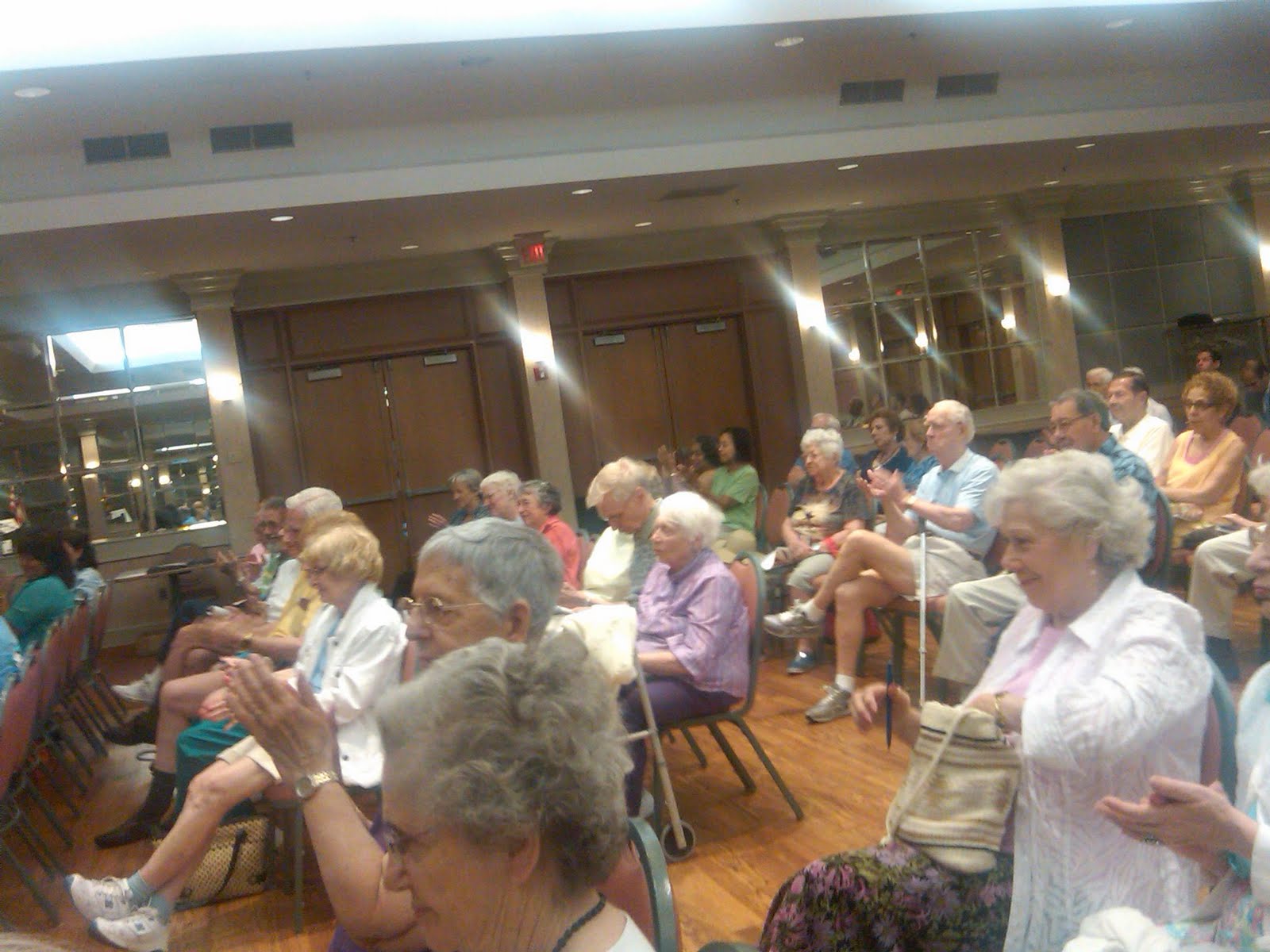
Today, I joined a colleague and ‘champion in the fight for quality healthcare,’ Senator Barbara Mikulski, as she hosted a health care town hall at Leisure World in Silver Spring. Being present today was important to me as we all continue the necessary dialogue around health care reform, what it means for you and me, and especially how it affects our senior Montgomery County residents. Others additionally addressing the Leisure World seniors were County Executive Isiah Leggett; Kathy Greenlee, Assistant Secretary for Aging, Administration on Aging (AoA), U.S. Department of Health and Human Services; and Jordan L. Harding, President of the Democratic Club of Leisure World.

Senator Mikulski spoke briefly to the empathetic group of her recent and very personal experience of needing in-home medical support. She went on to share that as she worked with fellow senators on crafting Health Reform legislation she found herself “living the need” that faces many Montgomery County residents and numerous American citizens; and that any reform efforts at the federal, state, or city council levels of government begins with people first and then finding the “will and wrought” to bring programs to fruition. I couldn’t have said it better.

The overarching tone by Mikulski in speaking about “The Affordable Care Act” (more commonly called “Health Care Reform”) was of one of transparency and the necessity of sticking to the facts. She firmly said, “No one will come between you and your doctor—not the government and not the insurance company! ... The Health Reform is the USA way, not the U.K. way; it does not involve the government interfering.” A summary of Senator Mikulski’s bulleted presentation on the new Health Care Reform follows:


Assistant Secretary Greenlee presented on the often-talked-about-but-seldom-clear issue of “Closing of the Doughnut Hole,” where the new legislation intends to phase out the “doughnut hole” effect created by Medicare Part D, the prescription drug benefit offered by the federal Medicare program. Following are key points from her presentation:

There were several questions directed at both Senator Mikulski and Assistant Secretary Greenlee on efforts to thwart growing physician resistance to accepting Medicaid patients, the effects of the reform on Veteran’s Affairs and the TRICARE health care program, and fighting Medicare fraud. Mikulski shared that Medicare Fraud was indeed a federal crime and those convicted faced stiff penalties according to the Federal Sentencing Guidelines, including serious jail time.

One last bit of information shared by Assistant Secretary Greenlee was the significant news that next year the Open Enrollment period necessary for seniors to participate in the Medicare Part D Prescription Drug plan will begin earlier, and will run from October 15, 2011 to December 7, 2011. This year’s Annual Coordinated Election Period will be from November 15 to December 31.
For More Information, contact or go to (bi/multi-lingual resources available):
http://www.healthreform.gov/
http://www.medicare.gov/
1-800-MEDICARE


- You Can Keep the Doctor You Have
- Annual Wellness Visits with the doctor of your choice (to audit your healthcare status and thus better enable prevention and early detection)
- Elimination of Co Pays and Deductibles for Prevention Screenings for both men and women (mammograms, heart disease screening, prostate screenings, cholesterol screenings)


Assistant Secretary Greenlee presented on the often-talked-about-but-seldom-clear issue of “Closing of the Doughnut Hole,” where the new legislation intends to phase out the “doughnut hole” effect created by Medicare Part D, the prescription drug benefit offered by the federal Medicare program. Following are key points from her presentation:
- Starting June 10, 2010 a one-time $250 rebate check will be automatically mailed to seniors who hit the doughnut hole in 2010
- Beginning January 1, 2011, seniors who become affected by the doughnut hole will (i) receive a 50% discount on brand name drugs and (ii) receive a 7% discount on generic drugs

For More Information, contact or go to (bi/multi-lingual resources available):
http://www.healthreform.gov/
http://www.medicare.gov/
1-800-MEDICARE
Monday, June 28, 2010
HHS-PS Committee Work Session Summary—Thursday June 24th
Members of the Public Safety (PS) and Health and Human Services (HHS) Committees received a briefing on the County’s current efforts to coordinate gang suppression and intervention activities across County departments, local municipalities, and neighboring jurisdictions including Prince George’s County.
BACKGROUND:
On May 26, 2010, Education Committee Chair Ervin requested that the Public Safety Committee discuss the coordination of gang suppression, prevention, and intervention activities due to recent alleged gang activity in the Silver Spring/Takoma Park area. The scope of the presentation was narrowed to focus on the coordination of suppression and intervention efforts for youth who are or have been gang-involved.
PRESENTATION/DISCUSSION SUMMARY:
A. Assistant Police Chief Wayne Jerman shared several gang crime statistics, including that during the 1st Quarter of 2010, there were 54 criminal incidents reported which were classified as gang-related incidents. These included crimes committed by an individual who is a gang member or associate, and crimes committed to benefit the gang, gang status, or for financial gain in furtherance of the gang. For the most recent reporting period, the 3rd District had the most reported gang incidents with 20, followed by the 6th District with 13.
B. Presently, Montgomery County receives funding from five primary gang grants, and all are used for three aspects of gang prevention, suppression, and intervention.
C. There is a pending Congressional Earmark for a Bi-County Gang Task Force with Prince George’s County. The grant would fund a MCPD Sergeant and two gang investigators, a Takoma Park Police gang investigator, a SAO Gang Prosecutor, and Correctional Gang Intelligence Officer, Gang Analyst, and Data Entry positions. The grant award is $2.7 million to be split evenly between Montgomery County and Prince George's County. If awarded, Montgomery County will share the funds between Law Enforcement/Suppression and HHS/Intervention.
D. There was a positive highlight on the integration of Regional Informational Databases and other technology, the chief of which was GangNet. The GangNet database allows gang-related information to be correlated, analyzed, and acted upon. The information can also confirm gang membership, size of the gang, regional movement/recruitment by gangs, types of crimes different gangs commit, gang territory, locations where gang members are stopped, vehicles used by the gang members, and can assist the State's Attorney’s Office at sentencing.
E. Councilmember Trachtenberg enquired whether any efforts were being extended in determining whether young people who became involved in gangs had a correlative history of family violence, substance abuse, or poverty in their homes. She expressed her support for the continued collaboration between public safety and health and human services organizations in formulating solutions that identify and intervene in the lives of young people. Kate Garvey (Health and Human Services), in responding, expressed that there has been some progress but she hoped that the future would bring a single service system.
F. Captain Dave Gillespie (Dept. of Police) felt that most intervention is based on age appropriate techniques that came from best practices. Warden Green told the Councilmembers that gang violence had its own dimensions within the correctional system; and when left to itself, it grows like poison—prevention/suppression/intervention funding and re-entry action are all necessary for the present and future well-being of Montgomery County.
Please contact Saschane Stephenson, Legislative Aide for Health and Human Services, at 240-777-7963 (direct dial) or saschane.stephenson@montgomerycountymd.gov with your questions regarding this HHS-PS Committee session.
BACKGROUND:
On May 26, 2010, Education Committee Chair Ervin requested that the Public Safety Committee discuss the coordination of gang suppression, prevention, and intervention activities due to recent alleged gang activity in the Silver Spring/Takoma Park area. The scope of the presentation was narrowed to focus on the coordination of suppression and intervention efforts for youth who are or have been gang-involved.
PRESENTATION/DISCUSSION SUMMARY:
A. Assistant Police Chief Wayne Jerman shared several gang crime statistics, including that during the 1st Quarter of 2010, there were 54 criminal incidents reported which were classified as gang-related incidents. These included crimes committed by an individual who is a gang member or associate, and crimes committed to benefit the gang, gang status, or for financial gain in furtherance of the gang. For the most recent reporting period, the 3rd District had the most reported gang incidents with 20, followed by the 6th District with 13.
B. Presently, Montgomery County receives funding from five primary gang grants, and all are used for three aspects of gang prevention, suppression, and intervention.
C. There is a pending Congressional Earmark for a Bi-County Gang Task Force with Prince George’s County. The grant would fund a MCPD Sergeant and two gang investigators, a Takoma Park Police gang investigator, a SAO Gang Prosecutor, and Correctional Gang Intelligence Officer, Gang Analyst, and Data Entry positions. The grant award is $2.7 million to be split evenly between Montgomery County and Prince George's County. If awarded, Montgomery County will share the funds between Law Enforcement/Suppression and HHS/Intervention.
D. There was a positive highlight on the integration of Regional Informational Databases and other technology, the chief of which was GangNet. The GangNet database allows gang-related information to be correlated, analyzed, and acted upon. The information can also confirm gang membership, size of the gang, regional movement/recruitment by gangs, types of crimes different gangs commit, gang territory, locations where gang members are stopped, vehicles used by the gang members, and can assist the State's Attorney’s Office at sentencing.
E. Councilmember Trachtenberg enquired whether any efforts were being extended in determining whether young people who became involved in gangs had a correlative history of family violence, substance abuse, or poverty in their homes. She expressed her support for the continued collaboration between public safety and health and human services organizations in formulating solutions that identify and intervene in the lives of young people. Kate Garvey (Health and Human Services), in responding, expressed that there has been some progress but she hoped that the future would bring a single service system.
F. Captain Dave Gillespie (Dept. of Police) felt that most intervention is based on age appropriate techniques that came from best practices. Warden Green told the Councilmembers that gang violence had its own dimensions within the correctional system; and when left to itself, it grows like poison—prevention/suppression/intervention funding and re-entry action are all necessary for the present and future well-being of Montgomery County.
Please contact Saschane Stephenson, Legislative Aide for Health and Human Services, at 240-777-7963 (direct dial) or saschane.stephenson@montgomerycountymd.gov with your questions regarding this HHS-PS Committee session.
HHS-PHED Committee Work Session Summary—Tuesday June 22nd
The Health and Human Services (HHS) and Planning, Housing & Economic Development (PHED) Committee met on Tuesday, June 22 regarding the Review of the Use of the Silver Spring Civic Building by the Round House Theatre.
BACKGROUND:
Both committees received a presentation from the Executive staff, Round House Theatre representatives and comments from the Chair of the Silver Spring Citizens Advisory Board regarding the Round House Theatre’s use of the new Silver Spring Civic Building and additional space in Silver Spring.
A few weeks prior to the work session, the Council received a letter from the Silver Spring Citizens Advisory Board (SSCAB) expressing concern about two issues related to the opening of the new Silver Spring Civic Building and Veterans Plaza. They felt that if Round House was going to receive the use of additional space at the Civic Building (which other groups might be able to use if Round House were not there) the County’s Lease Agreement with Round House should require that Round House contribute to the community. Additionally, the SSCAB reviewed the proposed fees for other spaces in the Civic Building and was concerned that the fees were too high for most community groups.
Several Broader issues that were discussed included the extent to which the County assisted non-profit organizations; and there was contemplation on the following:
A. The Executive Office, represented by Diane Schwartz –Jones, said they would maintain the agreement established with RHT, and that there would be evaluations on what would be fair modifications in light of changing fiscal climate and the fees paid by other nonprofits of equal maturity to RHT.
B. The SSAB recommended that stakeholder discussions be held on policy implications for the use of community space and to have a conversation that establishes clearer criteria for the accommodation of diverse arts and nonprofit community groups.
C. Most Councilmembers were in agreement that a re-evaluation of expectations was in order of what the County can feasibly continue to support, as it pertains to subsidizing leases and utility bills of nonprofits.
D. The Council asked Ms. Schwartz-Jones to provide a follow-up report on the final deal struck with RHT on their lease agreement at the new Civic Building.
Please contact Saschane Stephenson, Legislative Aide for Health and Human Services, at 240-777-7963 (direct dial) or saschane.stephenson@montgomerycountymd.gov with your questions regarding this HHS-PHED Committee session.
BACKGROUND:
Both committees received a presentation from the Executive staff, Round House Theatre representatives and comments from the Chair of the Silver Spring Citizens Advisory Board regarding the Round House Theatre’s use of the new Silver Spring Civic Building and additional space in Silver Spring.
A few weeks prior to the work session, the Council received a letter from the Silver Spring Citizens Advisory Board (SSCAB) expressing concern about two issues related to the opening of the new Silver Spring Civic Building and Veterans Plaza. They felt that if Round House was going to receive the use of additional space at the Civic Building (which other groups might be able to use if Round House were not there) the County’s Lease Agreement with Round House should require that Round House contribute to the community. Additionally, the SSCAB reviewed the proposed fees for other spaces in the Civic Building and was concerned that the fees were too high for most community groups.
Several Broader issues that were discussed included the extent to which the County assisted non-profit organizations; and there was contemplation on the following:
- The Round House Theatre is one of several arts and humanities organizations that receive substantial assistance because it is located in space owned by the County. Moreover, many organizations do not have the advantage of being in County space and must obtain and pay for space on their own.
- Some non-profit organizations that provide other types of services are housed in County space and others are not.
- Round House Theatre has been charging other nonprofits to rent the space that was leased to them by the County (for free at two Silver Spring locations, and for a $1 annually at a Bethesda location) and keeping the proceeds as revenue.
- Silver Spring has several very active non-profits which either have no space or inadequate space, while Round House is about to get more space.
A. The Executive Office, represented by Diane Schwartz –Jones, said they would maintain the agreement established with RHT, and that there would be evaluations on what would be fair modifications in light of changing fiscal climate and the fees paid by other nonprofits of equal maturity to RHT.
B. The SSAB recommended that stakeholder discussions be held on policy implications for the use of community space and to have a conversation that establishes clearer criteria for the accommodation of diverse arts and nonprofit community groups.
C. Most Councilmembers were in agreement that a re-evaluation of expectations was in order of what the County can feasibly continue to support, as it pertains to subsidizing leases and utility bills of nonprofits.
D. The Council asked Ms. Schwartz-Jones to provide a follow-up report on the final deal struck with RHT on their lease agreement at the new Civic Building.
Please contact Saschane Stephenson, Legislative Aide for Health and Human Services, at 240-777-7963 (direct dial) or saschane.stephenson@montgomerycountymd.gov with your questions regarding this HHS-PHED Committee session.
Wednesday, June 23, 2010
Joint HHS/PS Committee Work Session— Thursday June 24, 2010
A joint work session of the Health and Human Services (HHS) Committee and Public Safety Committee (PS) will be held on Thursday, June 24 at 2:00PM in the 7th Floor Council Hearing Room to discuss the following item:
The following individuals are expected to attend:
The following individuals are expected to attend:
- Assistant Chief Wayne Jerman, Department of Police
- Captain Dave Gillespie, Department of Police
- Deputy Chief Jeffrey Wennar, State’s Attorney’s Office Gang Unit
- Uma Ahluwalia, Director, Department of Health and Human Services (DHHS)
- Kate Garvey, Chief, Children, Youth and Families, DHHS
- Edward Newsome, Director of School Performance, Montgomery County Public Schools (MCPS)
- Robert Hellmuth, Director, Department of School Safety and Security, MCPS
Monday, June 21, 2010
Joint HHS/PHED Committee Work Session— Tuesday June 22, 2010
A joint work session of the Planning, Housing, and Economic Development (PHED) Committee and Health and Human Services (HHS) Committee will be held on Tuesday, June 22 at 2:30PM in the 7th Floor Council Hearing Room to discuss the following item:
• Review – Use of the Silver Spring Civic Building by the Round House Theatre
Please contact Saschane Stephenson, Legislative Aide for Health and Human Services, at 240-777-7963 (direct dial), or saschane.stephenson@montgomerycountymd.gov, with your questions or concerns regarding this joint PHED-HHS Committee session.
• Review – Use of the Silver Spring Civic Building by the Round House Theatre
Please contact Saschane Stephenson, Legislative Aide for Health and Human Services, at 240-777-7963 (direct dial), or saschane.stephenson@montgomerycountymd.gov, with your questions or concerns regarding this joint PHED-HHS Committee session.
HHS Committee Meeting Work Session—Monday, June 21, 2010
The Health and Human Services (HHS) Committee, on which Councilmember Trachtenberg serves, will meet on Monday, June 21, at 2:00PM in the 7th Floor Council Hearing Room to discuss the following item:
• Executive Regulation 7-10, Eating and Drinking Establishments - Nutritional Labeling
Please contact Saschane Stephenson, Legislative Aide for Health and Human Services, at 240-777-7963 (direct dial) or saschane.stephenson@montgomerycountymd.gov with any questions regarding this HHS Committee session.
• Executive Regulation 7-10, Eating and Drinking Establishments - Nutritional Labeling
Please contact Saschane Stephenson, Legislative Aide for Health and Human Services, at 240-777-7963 (direct dial) or saschane.stephenson@montgomerycountymd.gov with any questions regarding this HHS Committee session.
Tuesday, May 18, 2010
Summary: Tuesday May 18—HHS Agenda Items—FY11 OB Council Session
Members of the County Council addressed the following items under the Health and Human Services (HHS) division of the Recommended FY11 Operating Budget.
- Department of Health and Human Services
- Early Childhood Services, Infants and Toddlers, Child Care Subsidies, School Health Services, Linkages to Learning, Public Private Partnerships, Foster Care Transportation, and the Kennedy Cluster Project
- Resolution to establish the Montgomery County Organizational Reform Commission
Friday, May 14, 2010
Statement of Councilmember Duchy Trachtenberg at the Kensington Town Hall Forum
Good Evening. I’m Duchy Trachtenberg and I’m running for re-election to the Montgomery County Council, as an At-Large member.
When I raised my hand back in December of 2006 to take the oath of office, I understood the obligation I had to the residents of Montgomery County. For me, it was a continuation of my life’s work. During these last four years, I have strived to put people first and I have been hard-working and deliberate in my legislative actions, always willing to speak truth to power.
My priorities have been centered around children-their supports in school and out of school; public safety; public transportation; healthy and sustainable development; and the vulnerable, our most needy residents.
An example of this is the role I played in spearheading the Montgomery County Family Justice Center project into a reality. This is a clearinghouse facility that consolidates services for domestic violence victims and their children. In its first year of operation, over 1400 victims from over 100 countries have been served.
I helped lead the effort to reform our disability retirement system. I helped ensure that our procedures are based on a sound, public health foundation; that this important retirement benefit is preserved for those that are eligible; and that all employees have equitable access to the best medical practices.
As the Chair of the Council’s Management & Fiscal Policy Committee, I have worked with colleagues and the Executive branch to define over 2 billion dollars in savings during the first three budget cycles and presently I am playing an important role in defining our long-term fiscal plan in these most challenging times.
When I came to the Council building, I didn’t just want to fill an empty chair, I came to change lives. I believe I have done just that and I ask for your support tonight. Please vote on September 14th for Duchy Trachtenberg, Montgomery County Council, At-Large.
When I raised my hand back in December of 2006 to take the oath of office, I understood the obligation I had to the residents of Montgomery County. For me, it was a continuation of my life’s work. During these last four years, I have strived to put people first and I have been hard-working and deliberate in my legislative actions, always willing to speak truth to power.
My priorities have been centered around children-their supports in school and out of school; public safety; public transportation; healthy and sustainable development; and the vulnerable, our most needy residents.
An example of this is the role I played in spearheading the Montgomery County Family Justice Center project into a reality. This is a clearinghouse facility that consolidates services for domestic violence victims and their children. In its first year of operation, over 1400 victims from over 100 countries have been served.
I helped lead the effort to reform our disability retirement system. I helped ensure that our procedures are based on a sound, public health foundation; that this important retirement benefit is preserved for those that are eligible; and that all employees have equitable access to the best medical practices.
As the Chair of the Council’s Management & Fiscal Policy Committee, I have worked with colleagues and the Executive branch to define over 2 billion dollars in savings during the first three budget cycles and presently I am playing an important role in defining our long-term fiscal plan in these most challenging times.
When I came to the Council building, I didn’t just want to fill an empty chair, I came to change lives. I believe I have done just that and I ask for your support tonight. Please vote on September 14th for Duchy Trachtenberg, Montgomery County Council, At-Large.
Friday, May 7, 2010
Advocating for Children and Youth
Pat Salomon, MD, represented the Trachtenberg Office at a forum held on May 5, 2010 by Maryland’s Advocates for Children and Youth. At the forum, Uma Ahluwalia, the Director of Montgomery County’s Department of Health and Human Services showcased a system under development, called NO WRONG DOOR. Under this plan, Montgomery County DHHS is providing holistic care to our families in crisis. At the time a family presents for any type of help, a 14 point assessment is made to define what range of services are needed for this individual and their family. A plan is then made to access all the services needed. Multiple appointments are generated, the most urgent first, but with follow-through for all the necessary services. Then the entire team of providers continues to interact until the family is out of crisis and sustaining itself. Making all the services systems interoperable, and linking them technologically is a tall order, especially in the midst of a budget crisis, but the County’s DHHS is providing unique leadership across the country, to develop a coordinated response to families in crisis.
Trachtenberg Office Supports Welcome Back Initiative
The Trachtenberg Office was represented at the celebration of the Welcome Back Initiative, in Wheaton, on Wednesday, April 28, 2010. This program, launched through DHHS’s Latino Health Initiative, assists foreign trained health professionals to in Montgomery County, Prince George’s County and Frederick County to become fully licensed in the State of Maryland. Program participants study English as a Second Language, licensing exam preparation and are offered practice placements with the many cooperating hospitals and laboratories that are partners in this effort. This program is one of six across the country and expands the capacity of the counties involved to provide culturally diverse care of our community, which can only positively impact our health outcomes. Special kudos to Sonia Mora of the Latino Health Initiative, who brought the program to our County. She, along with County Executive Ike Leggett, was on hand to personally congratulate the 11 newest professionals completing the program. For more information, check out http://www.welcomebackinitiative.org/
Thursday, May 6, 2010
Summary—PHED/HHS Committee Work Session—Thursday May 6, 2010
Members of the Planning, Housing, and Economic Development Committee (PHED) and Health and Human Services (HHS) Committee met today to discuss several items within the FY11 Operating Budget Recommendations:
Following are a few of the actions taken:
Long Branch Tenant Counseling
--$12,960 will be added to the Reconciliation list for Council deliberation to close the remaining gap in the Long Branch Tenant Counseling Program.
HIF Debt Service and the Revised Tax Supported Fiscal Plan
--$15M in bond funding was approved in the FY11 CIP
Parent Resource Centers
--the PHED Committee agreed to place $48,160 on the reconciliation list.
Following are a few of the actions taken:
Long Branch Tenant Counseling
--$12,960 will be added to the Reconciliation list for Council deliberation to close the remaining gap in the Long Branch Tenant Counseling Program.
HIF Debt Service and the Revised Tax Supported Fiscal Plan
--$15M in bond funding was approved in the FY11 CIP
Parent Resource Centers
--the PHED Committee agreed to place $48,160 on the reconciliation list.
Wednesday, May 5, 2010
Joint PHED/HHS Committee Work Session—May 6—FY11 Operating Budget
A joint meeting of the Planning, Housing, and Economic Development (PHED) Committee and Health and Human Services (HHS) Committee will be held on Thursday, May 6, at 9:30AM in the 7th Floor Council Hearing Room to discuss the following item within the FY11 Operating Budget.
Please contact Saschane Stephenson, Legislative Aide for Health and Human Services, at 240-777-7963 (direct dial) or saschane.stephenson@montgomerycountymd.gov. with your questions or concerns regarding this joint PHED-HHS Committee session.
Please contact Saschane Stephenson, Legislative Aide for Health and Human Services, at 240-777-7963 (direct dial) or saschane.stephenson@montgomerycountymd.gov. with your questions or concerns regarding this joint PHED-HHS Committee session.
HHS Work Session Cancelled—Thursday May 6
The Health and Human Services (HHS) Committee meeting scheduled for Thursday May 6th has been cancelled.
Tuesday, May 4, 2010
HHS Committee Work Session FY11 —Wednesday May 5th
The Health and Human Services (HHS) Committee, on which Councilmember Trachtenberg serves, will meet on Wednesday, May 5, at 2:00PM in the 3rd Floor Council Committee Room to have discussions on the following items within the FY11 Operating Budget:
Please contact Saschane Stephenson, Legislative Aide for Health and Human Services, at 240-777-7963 (direct dial) or saschane.stephenson@montgomerycountymd.gov with any questions regarding this HHS Committee session.
Please contact Saschane Stephenson, Legislative Aide for Health and Human Services, at 240-777-7963 (direct dial) or saschane.stephenson@montgomerycountymd.gov with any questions regarding this HHS Committee session.
Joint HHS/ED Committee Work Session Summary—Tuesday May 4, 2010
Members of the Health and Human Services (HHS) and Education (ED) Committees met today to discuss items within the FY11 Operating Budget Recommendations:
Following is a summary of actions:
1. Early Childhood Services: Centro-Familio, Family Services, Inc.
The joint committees voted to approve funding. The matter moves to the Council for final vote.
2. Amendment to the Recommended FYll-16 Capital Improvements Program: School Based Health & Linkages to Learning Centers.
With no changes in expenditure and a return of approximately $100,000 to current revenue, the joint committees approved the amendment. The matter moves to the Council.
Following is a summary of actions:
1. Early Childhood Services: Centro-Familio, Family Services, Inc.
The joint committees voted to approve funding. The matter moves to the Council for final vote.
2. Amendment to the Recommended FYll-16 Capital Improvements Program: School Based Health & Linkages to Learning Centers.
With no changes in expenditure and a return of approximately $100,000 to current revenue, the joint committees approved the amendment. The matter moves to the Council.
Monday, May 3, 2010
Updated: Joint ED/ HHS Committee Work Session—Tuesday, May 4—FY11 Operating Budget
Updated: A joint meeting of the Education (ED) Committee and the Health and Human Services (HHS) Committee will be held on Tuesday, May 4, at 1:45PM in the 3rd Floor Council Committee Room to discuss the following item within the FY11 Operating Budget:
- Early Childhood Services: Centro-Familia, Family Services, Inc
- CIP: School Based Health and Linkages to Learning
Subscribe to:
Posts (Atom)